
Common Mistakes to Avoid in Your DNP Capstone Project

Composing a Doctor of Nursing Practice (DNP) project is a significant task that demonstrates a student’s analytical skills, capacity to translate evidence into practice, and ability to address real clinical problems, thereby positioning them as a serious scholar in the nursing field. However, the complexity of the DNP capstone project often presents students with challenges that may hinder their progress and compromise the quality of their work. Are you an advanced nursing practice student worried about making mistakes that can invalidate your DNP capstone project? You are not alone, as many nursing students face similar problems. With professional DNP project writing help, major errors can be avoided to guarantee an exceptional DNP project.
At DNP Nursing Project Help, we have skilled and experienced DNP writers who provide customized DNP capstone project writing help designed to save scholars time that would have been used in research and composing the document, and empower them to achieve their academic goals. In this article, we have discussed common mistakes to avoid when writing the DNP capstone project, some of which include utilizing informal language, poor data collection and analysis, and inconsistent referencing, and how scholars can keep away from them.
Common Mistakes to Avoid When Writing the DNP Capstone Project for Students
1. Vagueness
Vagueness occurs when scholars utilize imprecise language that contributes to the reader making guesses or incorrect assumptions about the student’s intended meaning in the DNP capstone project. Vagueness may occur in a DNP capstone project for various reasons, such as (a) overly general statements, (b) the student forgetting that the audience may not be proficient in nursing concepts, thereby leaving major details, (c) using long sentences, (d) a lack of evidence, and (e) words that have several meanings, among others. Using vague phrases can contribute to uncertainty and variable interpretation, which in turn reduces the credibility of the DNP capstone project. When writing the DNP project paper, it is essential to utilize clear and precise language and accurate medical terminology to illustrate ideas effectively for easy understanding by readers.
2. Using Informal Language
Using informal language involves applying a conversational writing style that features a casual tone and consists of short, simple sentences. Major characteristics of informal language in a DNP capstone project paper may include (a) first-person pronouns, (b) phrasal verbs, (c) personal tone, and (d) colloquial language and terms. Nursing papers, especially at the DNP level, should demonstrate the student’s ability to present well-reasoned arguments, critical thinking, and the ability to synthesize different perspectives. Applying informal language in the DNP capstone project paper negatively impacts its clarity and effectiveness. When writing the DNP capstone project, scholars should be direct in demonstrating that they are able to convey useful information accurately without ambiguity.
3. Changing Tenses
In a DNP capstone project, verb tenses are utilized to demonstrate when certain actions occur in relation to the project timeline. Generally, there are three simple verb tenses, which include the present, past, and future. Errors that can be made by scholars regarding tenses include, but are not limited to, (a) not changing the tense from future to past when composing the final DNP project from the proposal, (b) using the present tense for completed activities, and (c) applying inconsistent tones within the same chapters. When composing the DNP project proposal, the scholar should apply the present tense for the introduction, the past tense for the literature review, and the future tense for the methods (when writing the proposal). For the DNP project, students should apply the present tense for the introduction and the past tense for the literature, methods, results, and discussion. When discussing the implications in the conclusion, the DNP scholar should apply the present tense. If in need of DNP capstone project proposal writing services, our skilled writers can help with composing a well-structured and compelling proposal that acts as a strong foundation for our client’s nursing projects.
4. Referring to the Project as Research or the Student as a Researcher
According to the American Association of Colleges of Nursing (AACN) DNP Essentials, the DNP capstone project is a practice-focused project rather than a knowledge-generating research effort. For the DNP project, scholars should apply specific terms such as quality improvement, policy development, practice change, and the translation of evidence into practice. When writing the role references in the DNP capstone project, the scholar should utilize terms such as the DNP student to ensure that the purpose and professional roles are accurately presented.
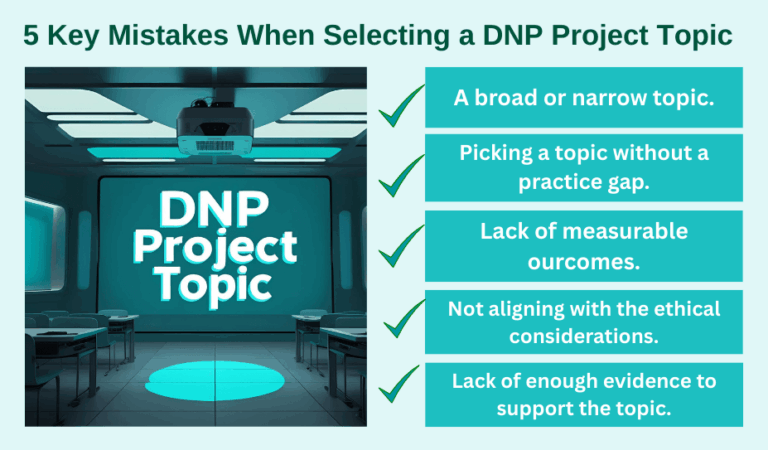
5. Selecting a Topic that Does Not Affect Nursing Practice
The DNP was developed to better equip nurses with the skills necessary to address the complex challenges within the healthcare system. Choosing a DNP project topic that does not directly affect nursing practice can contribute to a less impactful project through the lack of clinical relevance and alignment with the AACN Essentials. Factors that can contribute to formulating a topic irrelevant to nursing can be insufficient research to identify gaps, limited research resources, and a lack of professional nursing topic selection help. For those who need help with developing feasible topics for their DNP projects, our skilled writers create exceptional topics with high chances of approval and contribute to advanced nursing practice.
When considering a DNP capstone project topic, scholars should evaluate factors such as the project’s potential impact, success, and sustainability. The topic must have social, scientific, and practical relevance to patient care, healthcare providers, organizations, and the overall community.
6. Poor Data Collection and Analysis
Data collection for the DNP capstone project refers to the systematic procedure of gathering information from various sources to solve a clinical inquiry. Data analysis is the process of applying analytical tools and techniques to describe and analyze data to draw valid conclusions, enable informed decision-making, and contribute to better patient outcomes. Poor data collection and analysis in a DNP capstone project can contribute to inaccurate insights, invalid recommendations, and harmful changes to advanced nursing practice.
Various factors can cause poor data collection and analysis in a DNP capstone project, some of which include (a) poorly designed procedures, (b) data cleaning problems, (c) technological limitations, (d) insufficient documentation, and (e) methodology processes not aligning with the data analysis process. To minimize errors associated with data collection and analysis for the DNP project, scholars can hire our highly trained statisticians and analysts to conduct an accurate data analysis. We offer professional quantitative, qualitative, and mixed methods analysis and interpretation services for DNP students to help them present their results with clarity and precision.
7. Inconsistency in Referencing Sources and Citations
Referencing sources includes relevant publication information for the works used in the DNP capstone project paper. The aim of adding references and citations in a DNP capstone project paper is to give the original authors credit and allow readers to identify and evaluate the utilized sources. Inconsistency in referencing sources and citations in the DNP capstone paper affects the quality of the project, undermines its credibility, and may cause plagiarism. Errors in referencing may involve incomplete source details, applying an incorrect formatting style, paraphrasing without citing sources, in-text citations not matching the references, wrong or missing DOIs, inconsistent writing styles when adding citations, and mixing various citation styles. When writing DNP projects, scholars are advised to strictly follow the required writing style throughout the paper. Our professional writers have expert skills in formatting papers based on various writing styles such as APA, MLA, AMA, Chicago, and Harvard, among others. Hire our writers today for professional DNP project formatting.
Summary
The DNP capstone is a culminating project that is conducted to provide scholars with an opportunity to demonstrate their mastery of clinical skills and knowledge. When composing the DNP capstone project paper, students usually make mistakes that can impact the quality of their work, such as utilizing vague language, poor data collection and analysis, and improper use of tenses, among others.
Most students normally opt to get professional DNP capstone project writing help to evade typical mistakes that can undermine their work and increase the likelihood of a successful completion. By hiring our DNP-level experts, scholars get assistance with topic selection, refining their papers, data analysis, and referencing using the institution-specified writing style. Buy the best DNP capstone project writing services today by hiring our nursing writers. Once you leave us with the write my DNP capstone project or format my DNP project request, our expert writers have experience in all nursing courses and deliver exactly what our clients need. Contact us today or join our live chat; we are available 24/7 to respond to all your inquiries on time. Regardless of the deadline, we never compromise on the quality of our work.