
Tips for Writing a Clinical Practice Guideline DNP Project

One way DNP students can contribute to evidence-based change in a clinical setting is through the development of clinical practice guidelines that are based on scientific evidence. By constructing clinical practice guidelines, scholars can make a significant contribution to advanced nursing practice through establishing optimal care procedures that target healthcare professionals and patients. Are you a DNP student intending to compose a clinical practice guideline DNP project and would like help from a professional nursing writer? You are welcome to order our services, as we have experts with over 10 years of experience in writing exceptional DNP projects, tailored to your specific university guidelines.
Our professional nursing writers have expertise in writing impactful clinical practice guidelines for DNP’s that are based on the best scientific and recent evidence. In this article, we have highlighted exceptional tips for compiling a clinical practice guideline project, such as focusing guidelines on healthcare outcomes, applying a multidisciplinary approach, and utilizing the best available evidence, among others.
What is a Clinical Practice Guideline DNP Project?
A clinical practice guideline DNP project involves the development of a set of recommendations designed to improve healthcare outcomes that are based on the systematic identification and application of the best available evidence. DNP students develop clinical practice guideline projects to identify quality practices using the available evidence and contribute to better patient outcomes. Key benefits of developing clinical practice guideline projects by students conducting their DNP include: (a) Help in evidence-based decision-making, (b) formulate standards to guide and evaluate the clinical practices of healthcare professionals, (c) educate and train medical practitioners, and (d) provide excellent recommendations for the treatment of care.
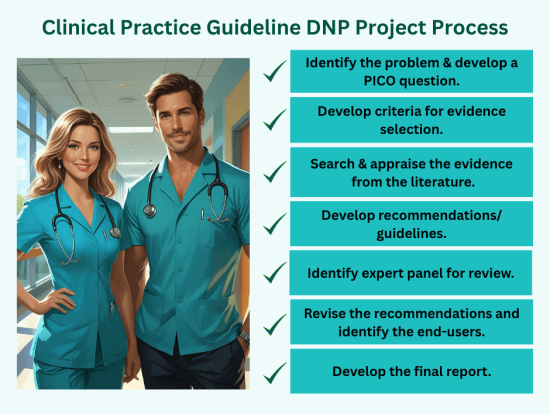
Essential Tips for Writing the Clinical Practice Guideline DNP Project
1. Focus Guidelines on Healthcare Outcomes
The significance of clinical practice guidelines is to enhance patients’ quality of care by promoting beneficial interventions and discouraging ineffective methods. When writing clinical practice guidelines, the DNP student should ensure that the guidelines are centered on healthcare quality and outcomes supported by evidence-based methods. To ensure clinical guidelines focus on healthcare outcomes, advanced practice nurses should consider patient needs and preferences and review and synthesize existing literature to develop recommendations for healthcare management. By focusing clinical guidelines on healthcare outcomes, nursing professionals are able to prioritize interventions with the most medical value.
2. Apply the Best Available Evidence and an Evidence Table
The best available evidence includes any high-quality information that can be synthesized to gain a better understanding of effective healthcare practices. In advanced nursing practice, evidence can be graded based on its level, relevance, quality, and strength. DNP students writing a clinical practice guidelines project can utilize the evidence hierarchy to locate the best evidence, where the first search is a systematic review or meta-analysis, and if not accessible, they can move to the next level of evidence to answer the question. Scholars should also include a statement about the strength of the recommendations provided. Clinical practice guidelines for the DNP based on the best evidence have the potential to improve the consistency of care, influence public policy, and control the planning of valuable interventions.
With the large and ever-increasing quantity of published sources in the nursing field, locating reliable and relevant evidence for developing clinical guidelines for the DNP project can be a difficult task. Students conducting a clinical practice guidelines DNP project can utilize evidence tables to document the main characteristics and findings from various studies. With an evidence table, the DNP students can identify gaps in practice and determine the strength of the evidence from the source used to compose the clinical guidelines.
3. Utilize the Strongest Method Applicable to Synthesize Evidence
Having information from a high-level study in the hierarchy of evidence does not automatically result in a good clinical practice guideline for the DNP project. The method utilized to integrate results should be the strongest applicable. The nursing scholar should apply a structured and transparent process to identify, evaluate, and synthesize research findings while also considering expert opinions and patient values. Using the best applicable method for combining findings from multiple sources for the clinical practice guidelines DNP project is important for developing reliable and efficient guidelines.
4. Use a Multidisciplinary Approach for Guideline Development
If the clinical practice guidelines for the DNP project are to be relevant, the individuals who benefit from their use should participate in the development. The DNP scholar can apply a multidisciplinary approach to their project by involving health professionals, patients, specialist clinicians, pharmacists, or social workers, among others, to improve the likelihood of the guidelines being implemented. Integrating diverse expertise and perspectives in the clinical practice guidelines DNP project enables scholars to contribute to better patient care and improved healthcare systems.
5. Develop Adaptable Guidelines to Different Clinical Settings
The clinical guidelines developed for the DNP project should be implemented without modification in a different healthcare setting other than the one for which it was designed. There are four key approaches that DNP students can apply for guidelines adaptation in different healthcare settings, which include (a) developing clinical practice guidelines from existing guidelines, (b) implementing established guidelines where applicable, (c) updating guidelines based on current evidence, and (d) addressing conflicting recommendations between various guidelines. Developing adaptable guidelines for the DNP project ensures the relevance of recommendations and usability in diverse clinical settings, thereby improving patient outcomes.
6. Consider Resource Constraints
It is important to make well-informed and cost-effective healthcare decisions to enable affordable medical costs, and one method of contributing to this is by incorporating an economic appraisal in clinical practice guidelines projects. By addressing economic considerations in the clinical practice guidelines, the DNP project improves the feasibility of the study and ensures implementation. Including resource constraints when writing the clinical practice guidelines also demonstrates to the DNP student their awareness of limited resources.
7. Evaluate the Impact of Guidelines
Assessing the impact of clinical practice guidelines is important for healthcare quality improvement and better patient care. Students conducting a clinical practice guideline DNP project can evaluate the implementability of guidelines using tools and frameworks such as the GuideLine Implementability Assessment (GLIA) tool or the conceptual framework. By evaluating and determining the effectiveness of the clinical practice guidelines, the DNP student can help in reducing healthcare expenditure, enhancing patient care, and promoting a rational allocation of medical resources.

Examples of Clinical Practice Guidelines DNP Projects
- Constructing a clinical guideline on the appropriate use of point-of-care ultrasound in patients with Acute Dyspnea in an Intensive Care Unit (ICU) setting.
- Designing a clinical guideline for the pharmacologic treatment of low bone mass to reduce fractures in elderly adults.
- Developing a clinical practice guideline to reduce acute low back problems among adult women aged 30-60 years.
- Formulating and testing a clinical practice guideline for handling urinary incontinence among adult women in a primary care setting.
- Developing a clinical practice guideline to apply quality mammography to ensure accurate breast cancer screening and diagnosis among adult women.
Summary
Clinical practice guidelines are statements that contain useful recommendations intended to optimize medical care that are informed by the best evidence and an evaluation of the benefits and drawbacks of alternative care methods. By developing clinical practice guidelines for their DNP project, scholars can improve the translation of research into nursing practice and improve healthcare outcomes. In case you are looking for professional help with writing a clinical practice guideline DNP project, we have experienced nursing writers who specialize in clinical practice.
One thing that makes us unique is that we deliver the tasks we have written before the actual due date so that our clients can review and request amendments if need be, before the submission date. Also, we have quality checks to ensure the final paper delivered to our clients is free of errors and logic. For the best clinical practice guidelines DNP project writing services, reach out to our professional nursing consultants for personalized assistance. We are available 24/7 to respond to your inquiries promptly. Contact us now or have a live chat with our friendly customer service agents who will guide you through our process.