
Nursing School Requirements: A Comprehensive Guide for Aspiring Nurses

Nursing schools have established clear and precise admission requirements ranging from academic qualifications to personal skills to identify eligible candidates who are intellectually equipped and can handle the challenges of an intensive nursing curriculum. Selecting the right scholars who meet the required standards helps ensure patient safety, well-being, and better healthcare outcomes. For those searching for expert help with composing nursing school application documents, our skilled writers develop papers required when applying for nursing school, such as statements of purpose, letters of recommendation, personal statements, and personal essays, among others.
Our company comprises DNP graduates and nursing specialists who have extensive knowledge of what is expected of nursing school applications and what to include in the documents to increase chances of approval. Ordering our services guarantees quality work, timely delivery, and free revisions for our clients. From academic prerequisites to entrance exams, this article has highlighted the important qualifications scholars need for admission into the nursing degree program of their choice. We have also stated various reasons why nursing schools reject applications.
What is Nursing School Like?
Nursing school is a specialized educational institution that is designed to prepare individuals to become competent and qualified nurses by developing their clinical judgment in the provision of care to help patients improve, maintain, and recover their health. The nursing curriculum consists of comprehensive coursework offered online, hybrid, or in-person, clinical hours, and practical skills training using simulations, see the BSN to DNP program curriculum options. The primary aim of nursing school is to equip scholars with the knowledge, skills, and competencies that will prepare them to become professional medical practitioners and be capable of providing effective patient care in health care delivery institutions. By enrolling in nursing school programs, students can:
- Maximize the effectiveness of health systems and contribute to improved nursing care.
- Provide clinical leadership to ensure safe, high-quality, and efficient healthcare delivery.
- Develop theoretical knowledge and useful skills that facilitate an in-depth understanding of current and emerging trends related to nursing practice.
- Promote health equity, reduce health disparities, and contribute to the well-being of every patient.
Essential Requirements for Getting into Nursing School
1. Minimum GPA Scores
The Grade Point Average (GPA) is a summary statistic that represents a scholar’s average performance in their studies over a specific period. Nursing school admissions are usually competitive, and having good grades and an above-average GPA is a key requirement for acceptance. Minimum GPA score requirements generally vary from one nursing school to another based on factors such as the specific program (CNA, ADN, BSN, MSN, or DNP), competitiveness of the nursing institution, and the applicant pool. Nursing programs typically require a college or high school GPA of 2.8 to 3.0 or higher. To determine the minimum GPA score required at their nursing school of choice, scholars should consult their admission representatives.
2. Completion of a Nursing Entrance Exam
Registered nursing programs are competitive, and the coursework can be challenging, so most nursing schools develop entrance exams to evaluate the prospective student’s academic aptitude. Nursing school entrance examinations are designed to provide nursing programs with specific information related to an applicant’s abilities in content areas that serve as a foundation for nursing courses, such as physical sciences, mathematical, and verbal ability, among others. Each nursing entrance exam is different, with distinct formats and scoring systems, so scholars should conduct comprehensive research to determine the entrance exam to take. Some of the common nursing entrance exams for aspiring nursing students include:
- Nursing Entrance Test (NET)
- Test of Essential Academic Skills Exam (TEAS)
- National League for Nursing Pre-admission Exam (PAX)
- Kaplan Nursing School Admission Test
- Health Education Systems, Inc. Admissions Assessment (HESI A2)
- PSB Aptitude for Practical Nursing Exam
- PSB Health Occupations Aptitude Exam
- PSB Registered Nursing School Aptitude Exam
To adequately prepare for nursing school entrance exams, students should develop a study plan to track their preparation and master the format of the test to familiarize themselves with the type of questions that will be encountered. Passing nursing entrance exams demonstrates the scholar’s academic readiness and commitment to the nursing profession, therefore increasing chances of approval.
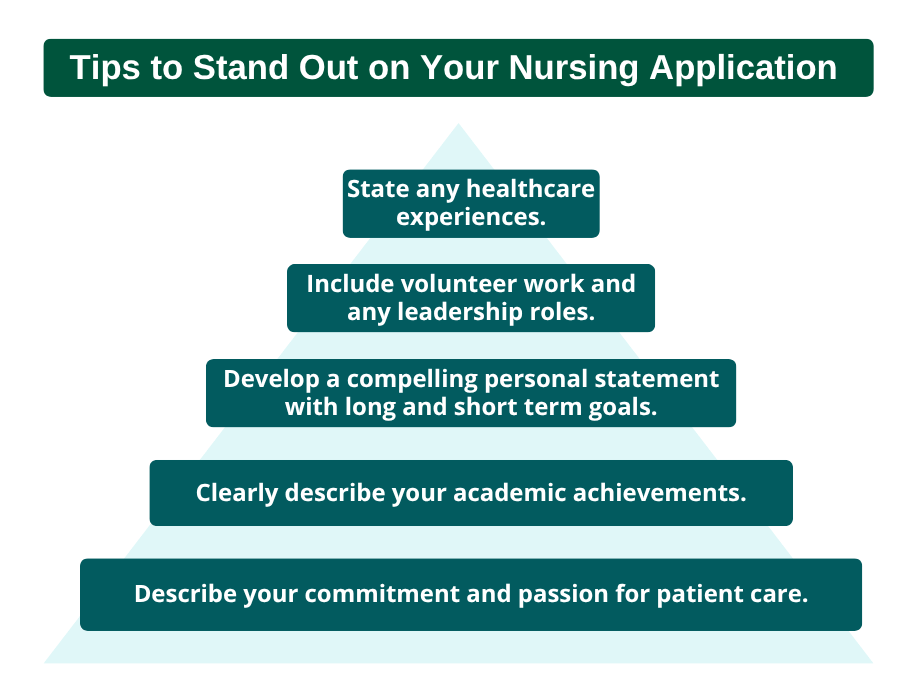
3. Personal Statement
The personal statement is a document about the applicant that is composed to persuade the reader to positively consider the applicant’s key traits, experiences, qualifications, and aspirations for selection or further consideration. As a brief representation of the scholar’s attributes, the personal statement should comprise their accomplishments, lessons learned, professional vision of themselves, and traits such as integrity, commitment to the nursing profession, enthusiasm, and perseverance. An exceptional personal statement should have evidence of the student’s reflection on the career path and align with the nursing school’s vision. Including the evidence of a growth mindset and a comprehensive self-analysis helps the reader to learn the applicant’s strengths and weaknesses. When writing the personal statement, the student should include relevant examples that illustrate their qualities as highly desirable for the nursing school application.
The personal statement typically consists of three sections, which are the introduction, body, and conclusion. The introduction should be engaging to capture the attention of the reader. The body should have a logical order and describe the experiences that influenced the selection of the nursing school, research conducted to capture interest in the field, and useful personal skills, among others. The conclusion should contain a reflection of the personal experiences relevant to nursing, a synthesis of the scholar’s achievements, and the main lessons learned. In case you need help crafting an excellent personal statement that stands out among other candidate applications, consider ordering our trusted personal statement writing service to get a document that presents your unique skills and strengths. After admission, we also help students with the nursing tasks such as research papers, data analysis, essays, and SOAP notes, among others, as the scholars concentrate on their practice and educational tasks.
4. Completion of Prerequisite Courses
The fundamental anatomy, biology, chemistry, physiology, microbiology, mathematics, psychology, and statistics are often necessary prerequisites for nursing programs. Aspiring nurses are usually required to complete courses because they offer foundational knowledge of the human body, scientific principles, and data interpretation, which are all critical aspects of being a good nurse. Prerequisite courses also teach scholars soft skills such as communication, teamwork, and writing. Additionally, completing prerequisite courses is important because registered nurses are prepared to perform tasks such as composing patient reports and working with a multidisciplinary team. To learn about the required courses and validity period of the prerequisites for the prospective nursing school, contact the admissions office to get specific information. Exceptional performance in the courses can enhance the scholar’s nursing school application and prepare them for the comprehensive nursing curriculum.
5. Recommendation Letters
Recommendation letters are important in the nursing school application process as they provide an objective evaluation of the scholar from an uninterested third party. The requirements for recommendation letters vary among different nursing schools, but most require one to three letters. Before requesting recommendation letters, the student should decide on who to ask, such as supervisors, mentors, or employers, who can attest to their skills, performance, ethics, and personal attributes.
When asking for a recommendation letter, the student should mention the due date for submission, what to include in the document, relevant information about the nursing school, the reason for choosing the individual writing the letter, and specific skills to be included. By submitting strong letters of recommendation, scholars can improve their applications and increase the chances of approval into the nursing program. Should you need help with composing a compelling letter of recommendation, we have a team of skilled nursing writers dedicated to composing exceptional and personalized letters of recommendation that increase the chances of acceptance into the nursing school.
6. Statement of Purpose
The statement of purpose enables the nursing school’s admission committee to evaluate the student’s career aspirations, professional contributions, goals, subject proficiency, and motivation for pursuing the nursing program. The statement of purpose typically consists of (a) personal background, (b) academic details, (c) professional experiences, (d) short and long-term goals, (e) reasons for selecting the nursing school, and (f) interests and hobbies. For professional statement of purpose writing help, hire our skilled writers for professional statements of purpose that will improve your acceptance rates.
Besides recommendation letters, statements of purpose, and personal statements, our nursing writing services are comprehensive as we provide expert help with other nursing documents such as dissertations, capstone projects, reflective essays, and care plans, among others. We also provide editing and proofreading, and rewriting services to eliminate errors and refine nursing documents to achieve well-structured papers that align with the best nursing practice standards. Looking for a nursing writing service you can trust? Hire our DNP-level writers today for personalized nursing writing help.
What are the Common Reasons Why Nursing Schools Reject Applications?
- Missing or incomplete prerequisites can contribute to automatic rejection.
- Low GPA scores.
- Subpar standardized test scores.
- Weak applications, such as a poorly composed personal statement.
- Limited spots in nursing programs.
- Weak collaboration and communication skills.
- Focusing on the application at one nursing school.
- Generic letters of recommendation that do not demonstrate the scholar’s useful skills and qualifications.
- Failure to meet health requirements.
Summary
Nursing schools normally have specific admission requirements to identify suitable candidates who can handle the demanding nature of the intensive nursing curriculum. Some of the key requirements for admission into nursing school include, but are not limited to, completion of a nursing entrance exam, the program’s minimum GPA score, letters of recommendation, personal statement, and accomplishment of prerequisite courses. Enrolling in nursing school is an important step towards career development in healthcare. By conducting thorough research, composing an excellent personal statement, and getting effective letters of recommendation, scholars can create a successful application. If you need expert assistance with applying to nursing school, reach out to our professional nursing consultants for specialized assistance now by joining our live chat to talk to our customer service agents or by contacting us. We are available 24/7 and ensure we respond to all our clients’ inquiries promptly. In addition, we ensure the timely delivery of tasks without compromising on quality and keep our clients’ information confidential.